Learning & Capability Development
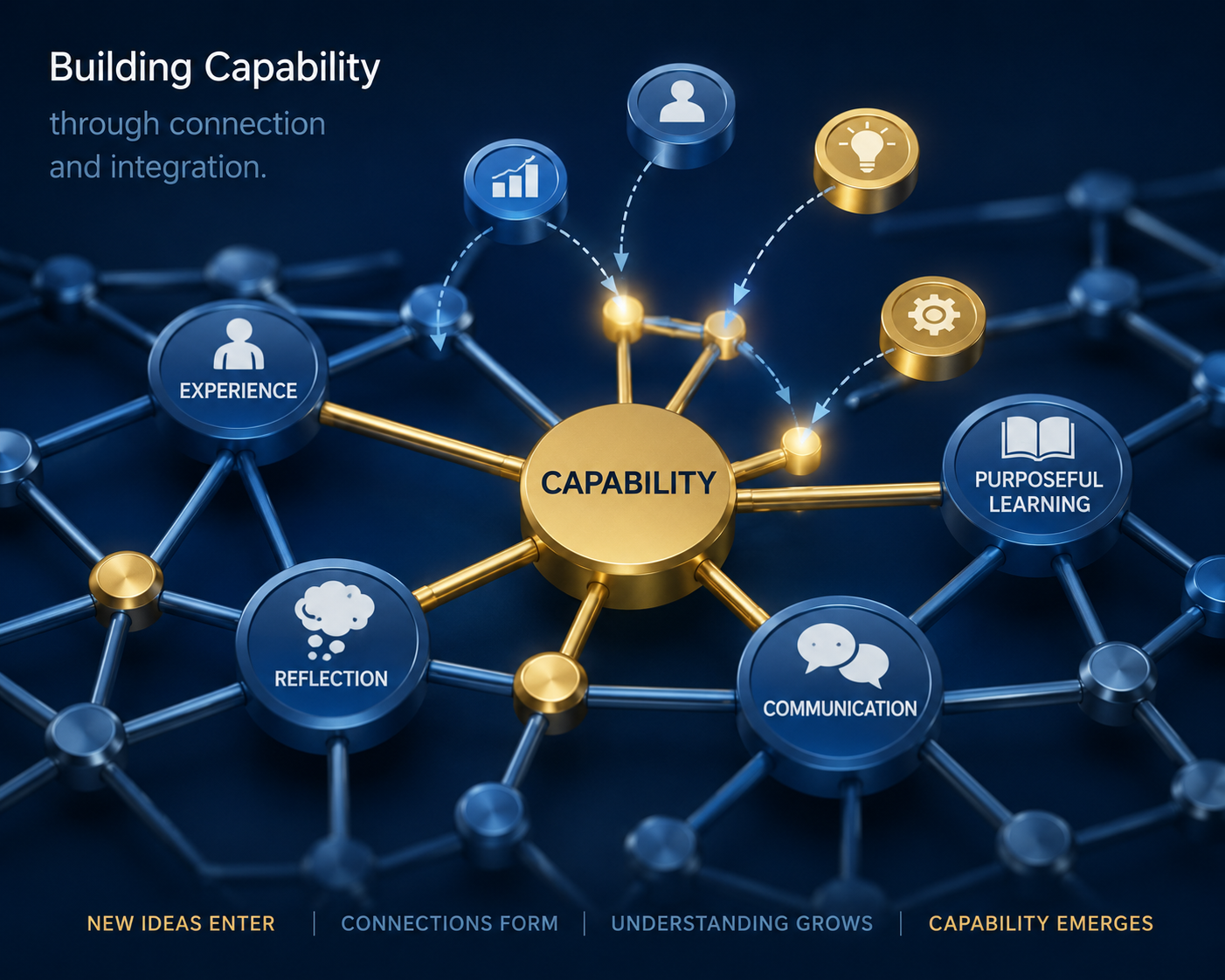
Capability is not delivered. It is continually constructed through the integration of experience, reflection, communication, and purposeful learning.
At Technocrats, we help organizations create the conditions that positively influence the development of individual and organizational capability. Whether through communication, technology, project coordination, documentation, or learning design, our objective is the same: to help people build a clearer understanding of their work so they can adapt, collaborate, and perform with confidence.
Learning Events Are Part of the Journey Toward Capability
A course, video, guide, or learning platform can support learning, but the media is not the destination. The real work is helping people move move from exposure to integration, from integration to confidence, and from confidence to effective action.
That journey matters because organizations are rarely asking people to remember isolated facts. They are asking people to navigate relationships among tools, processes, expectations, and responsibilities that often connect across teams.
When learning is designed around the journey, it does more than explain what to do. It helps people build a clearer understanding of where they are, what is changing, why it matters, and how their own knowledge connects into a larger whole.
Influencing the Trajectory of Capability
Every person already possesses a conceptual model shaped by experience, communication, reflection, and prior learning. Organizations cannot replace that model, nor can they directly deliver capability.
What they can do is influence its trajectory.
Purposeful learning experiences help people integrate new ideas into the models they already use to interpret their work. As those models become richer, more connected, and more closely aligned with organizational goals, capability naturally develops.
How Capability Is Built
Capability emerges when people understand the tools, processes, expectations, and relationships that shape their work. Learning helps build the connections that make that possible.
Experience
The existing models, assumptions, skills, and context people bring to the work.
Integration
The process of connecting new ideas to existing models in ways that can guide decisions and action.
Capability
The observable ability to adapt, decide, collaborate, and perform more effectively.
Learning Design That Supports Real Work
Effective learning does not simply improve present performance. It expands the learner's capacity to integrate future experiences.
Depending on the need, that may include instructor-led sessions, self-paced learning, video, documentation, job aids, workshops, knowledge transfer, or blended approaches. The format should serve the learning need, not the other way around.
Good learning design helps people expand and refine the mental models they already use to make decisions and solve problems.
Creating Shared Understanding
Organizations rarely struggle because information is unavailable. They struggle because conceptual models differ.
People may use the same words while meaning different things. Teams may understand their own responsibilities but not how those responsibilities connect to others. Leaders may see the destination while learners are still trying to understand the path.
We help close those gaps by designing communication and learning structures that make assumptions visible, clarify relationships, and support better alignment across people, processes, and systems.
Supporting Learning Technologies
Technology plays an important role in delivering, organizing, and sustaining learning. Learning platforms can help organizations scale knowledge, support distributed teams, track participation, and maintain consistency across programs.
Technology remains an important part of the solution, but it is never the destination.
The destination is capability.
Building Capability
Organizations cannot deliver capability.
They can create experiences that positively influence its development.
When people integrate new ideas into the models they use to guide action, capability becomes visible through better decisions, stronger collaboration, and more adaptable performance.
That is where meaningful organizational change begins.